Case study · DigiRadio · open hardware
A 6-layer DAB+/FM radio, checked before fab.
DigiRadio is an open-source portable digital radio designed in KiCad 10: DAB, DAB+ and FM, a SigmaDSP audio hub, Bluetooth, optical S/PDIF and a Li-ion battery charged from USB-C, on one board of 89 × 187 mm. This is what BoardLab found on it, and what changed before it was ordered.
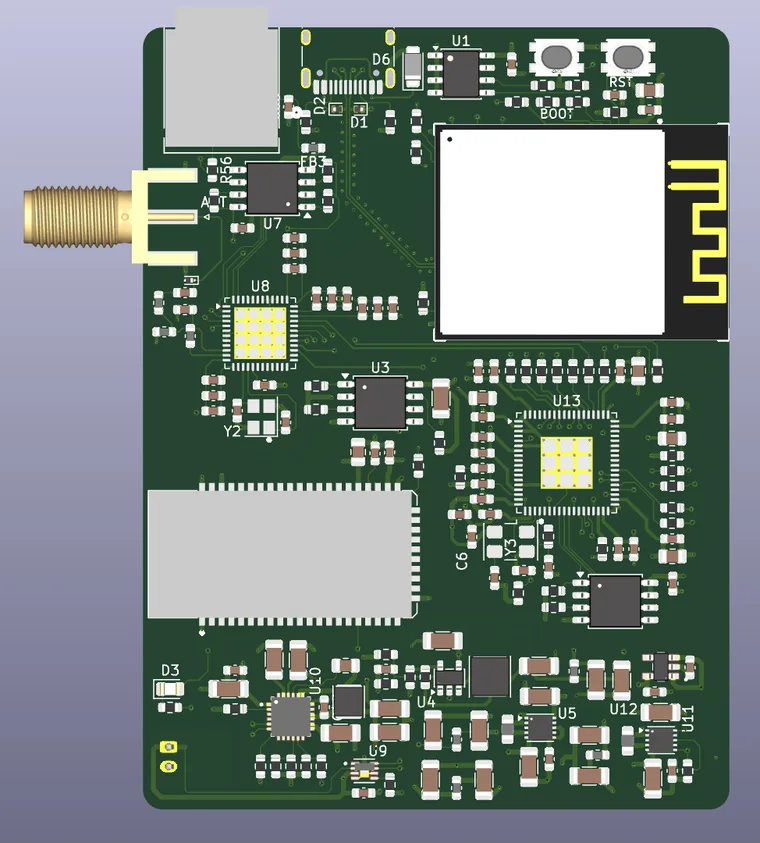
The board
Four domains on one PCB.
The KiCad project went in as it is: hierarchical schematic sheets, the .kicad_pcb and the project file, no export step. BoardLab read the datasheet of each of the 14 ICs, checked all 183 parts and recognised 8 standard interfaces.
Radio
Silicon Labs Si4684 for DAB, DAB+ and FM, with its 19.2 MHz crystal and SPI flash.
Control
Espressif ESP32-S31-WROOM-3 with 128 Mbit of flash and a USB-C port.
Audio
Analog Devices ADAU1452 SigmaDSP: three I²S inputs, optical S/PDIF out, boot from SPI EEPROM.
Power
TI BQ25896 charger, MAX17048 fuel gauge, two TPS63031 buck-boost converters, a TPS7A20 LDO and a TLV62568 buck.
Before and after
Found on the earlier revision, fixed before fab.
Each of these came out of a BoardLab review with its evidence: the measured fact on the board, the datasheet rule with its page, and the action. They are the details that are easy to miss by eye and cheap to fix before ordering.
| Found by BoardLab | Fixed before fab |
|---|---|
| Y2 and Y3 crystals: load capacitors in X7R, a dielectric that drifts with temperature and voltage | 12 pF ±5% NP0, 50 V, 0603 (C139–C142) |
| ADAU1452 1.2 V pin 20 without the decoupling its datasheet asks for | 1 µF added (C6), trace widened to 0.35 mm |
| U14 EEPROM, a 208 mil SOIJ-8, placed on a 150 mil SOIC footprint | SOIC-8 5.3 mm footprint |
Protocol certifier
8 interfaces, 8 certificates, with the numbers.
An interface is certified only when every rule has both a limit and a measurement on the actual copper. Where no standards body publishes a spec, the grade rests on the chips' datasheets plus stated BoardLab rules, and the report says so.
Still on the list
No blockers, and an honest list of what to review.
The verdict on the current revision has no blockers. A short list of layout points stays open for the designer, each with its evidence. Two examples:
Thermal vias under the DSP
The via field under the ADAU1452 exposed pad is about 37% of what its datasheet shows.
Input capacitor distance
The input capacitor of a buck-boost converter sits 4.2 mm from its VIN pin.
Temperature and EMI
Junction temperature of every IC from its datasheet thermal data at 25 °C ambient, and an advisory EMI risk map on the layout.
Figures from the BoardLab analysis of 3 November 2026. DigiRadio is released under CERN-OHL-S-2.0: schematics, layout and Gerbers are on GitHub. Your first board up to 30 ICs is analysed free; DigiRadio, with 14 ICs, fits in it. Pricing